Introduction
Most manufacturers are not short on data. In fact, they are often drowning in it. Every shift generates thousands of data points across individual machines, quality systems, ERP platforms, and the broader supply chain. However, despite this digital deluge, most manufacturers are still short on actual decisions.
At the end of a long week, many plant managers are still relying on gut feel, personal experience, and whatever static report happened to land in their inbox that morning. This massive gap between raw data and a concrete decision is where efficiency is lost, hidden costs accumulate, and your competitive advantage quietly disappears. Success in data-driven manufacturing is not about who has the most data. It is about who can translate that data into action the fastest.
Why Manufacturing Data Rarely Becomes a Decision
As highlighted by Rockwell Automation, many manufacturers struggle with connected decision-making, where data exists but is not effectively translated into timely actions across operations. There are three primary reasons why production data often sits unused in a server. First, a lack of a cohesive manufacturing data strategy means that information often lives in disconnected manufacturing data silos with no common language between them. The maintenance team sees one thing, while production sees another. Second, data frequently arrives too late to influence the specific moment that needed it. Third, information often reaches the wrong person in a format they cannot use.
A maintenance engineer drowning in raw sensor logs cannot make the same tactical call as a plant manager looking at a unified production summary. Without proper manufacturing data governance, data remains a burden rather than a tool.
The Journey From Raw Data to Actionable Decision
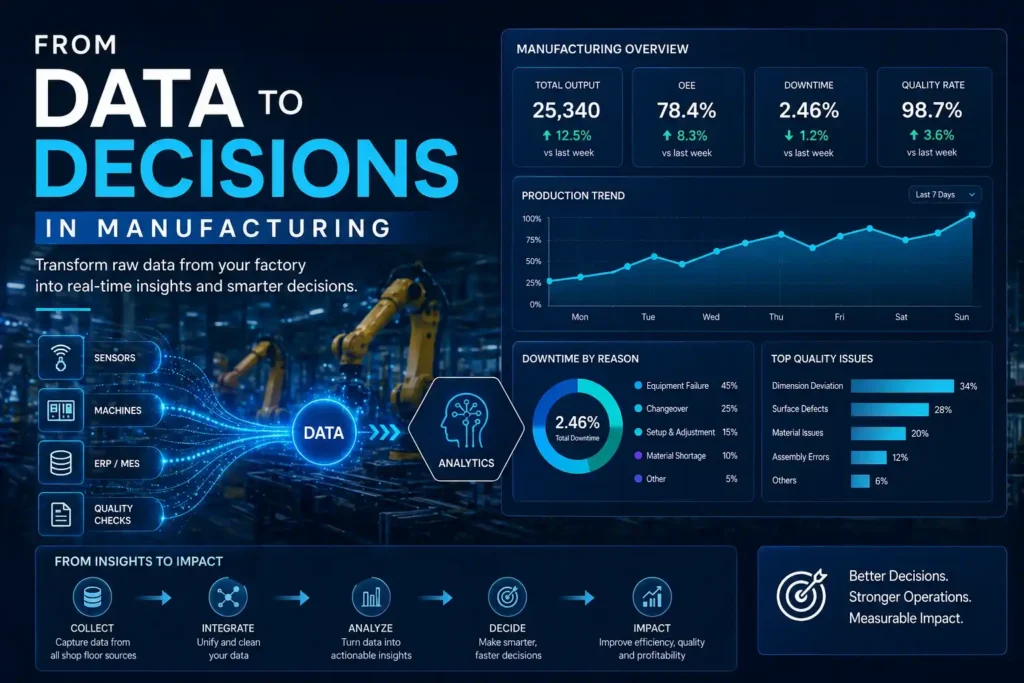
To turn manufacturing data analytics into a competitive weapon, information must move through five distinct stages. This process transforms a series of numbers into a clear directive for the shop floor.
Stage 1: Collect The journey begins by gathering data from IoT sensors, machines, ERP, MES, and SCADA systems continuously and automatically. Manual data entry is the enemy of accuracy. By capturing the heartbeat of the factory in real time, you ensure that the foundation of your manufacturing decision making is built on what is actually happening, not what an operator remembers happening.
Stage 2: Unify Once collected, all data sources must be connected into one centralised platform. This is where you break down the silos. No more jumping between three different software applications and four different spreadsheets to understand why a line is down. By creating one version of the truth, you ensure that every department is looking at the same reality.
Stage 3: Contextualise Raw data is meaningless without business context. A temperature reading of 200 degrees is just a number until it is contextualised as a critical maintenance signal for a specific bearing. A throughput number only becomes a shift performance insight when compared against the current target and historical averages. This stage is where operational analytics in manufacturing begins to provide real value by giving raw signals a specific meaning.
Stage 4: Analyse In this stage, real time dashboards and predictive models surface the patterns that actually matter. Instead of making a human search for an anomaly, an industrial data intelligence platform highlights it automatically. This moves the organisation away from looking at everything and toward looking at the right things.
Stage 5: Decide This is the final and most important step. The right insight reaches the right person at the right moment with a clear recommended action attached. This is how you move from manufacturing data to actionable insights. Instead of a report that says production was low, you get a directive that tells the supervisor to adjust a specific setting to bring the line back into tolerance.
What This Looks Like in Practice
When you move away from static reports and toward operational intelligence in manufacturing, the results are tangible and immediate.
Consider a quality deviation detected at Stage 3 of production rather than at the final inspection. Because the data was analysed in real time, the supervisor can stop the line immediately, saving an entire batch of material that would have otherwise been scrapped.
In another scenario, plant performance analytics might flag a machine for maintenance three days before a projected failure, allowing the team to avoid four hours of unplanned downtime by performing a quick fix during a natural shift change. When a demand spike is identified in supply chain data, it can trigger a production schedule adjustment 48 hours before a shortfall ever occurs.
In each of these cases, the data travelled through the five stages and landed as a decisive action that saved time and money.
The Role of Manufacturing Data Governance
One area most discussions on this topic skip entirely is the necessity of trust. Data that is not trusted will never be used to make a high stakes decision. This is why manufacturing data governance is the secret ingredient in any successful manufacturing data strategy.
If the maintenance department and the finance department are using different definitions for OEE, the decision making process will break down before it starts. Governance ensures that every metric is standardised, every data source is validated, and every number means the same thing to everyone in the organisation. It is the bedrock that ensures manufacturing analytics ROI is actually realised, not just promised.
What Manufacturing Leaders Gain
The transition to a truly data-driven manufacturing model changes the entire trajectory of a business. Leaders gain the ability to make critical decisions in minutes rather than days. The operation shifts from reactive firefighting to proactive optimisation.
By establishing a single source of truth, you eliminate the friction between departments and ensure everyone is pulling in the same direction. The result is a measurable manufacturing analytics ROI that compounds over time. When every decision is grounded in live production data insights rather than last week’s printed report, the factory becomes faster, leaner, and significantly more profitable.
Frequently Asked Questions
1. How do manufacturers turn raw data into actionable decisions?
They follow a structured five-stage process: collecting data automatically, unifying it in a central platform, adding business context, analysing it for patterns, and delivering a specific recommended action to the right person at the right moment.
2. What is operational intelligence in manufacturing?
It is the practice of using real-time data to manage daily shop floor activities. Unlike traditional business intelligence, which looks at the past, operational intelligence focuses on what is happening now and what needs to happen next.
3. How long does it take to go from data collection to decision-making capability?
With the right industrial data intelligence platform, basic visibility can be achieved in weeks. Advanced predictive decision making typically matures over a few months as the system learns the specific patterns of your operation.
4. What is the ROI of manufacturing analytics investment?
ROI is typically seen through reduced downtime, lower scrap rates, and improved OEE. Most manufacturers see a significant return by preventing just one or two major unplanned outages that would otherwise have cost far more than the platform itself.
Conclusion
The data your factory generates every shift is one of your most underused strategic assets. The manufacturers pulling ahead in today’s market are not necessarily generating more data than their competitors. They are simply doing more with the data they already have.
Closing the gap between a data point and a decision is the most effective way to drive long term growth. If you are ready to transform your operations through manufacturing operational intelligence, the first step is connecting your machines to your managers.