Introduction
The industrial data management market is currently valued at over $105 billion and is projected to reach $213 billion by 2030. Manufacturers are clearly spending. But spending on data collection and storage is not the same as spending on intelligence.
Most industrial operations today are data rich and decision poor. Every machine generates signals. Every system logs events. Every shift produces thousands of data points that flow into servers and sit there, largely untouched. Without the intelligence layer to make sense of it all, those signals remain noise. That is exactly what industrial data intelligence was built to solve.
What Is Industrial Data Intelligence?
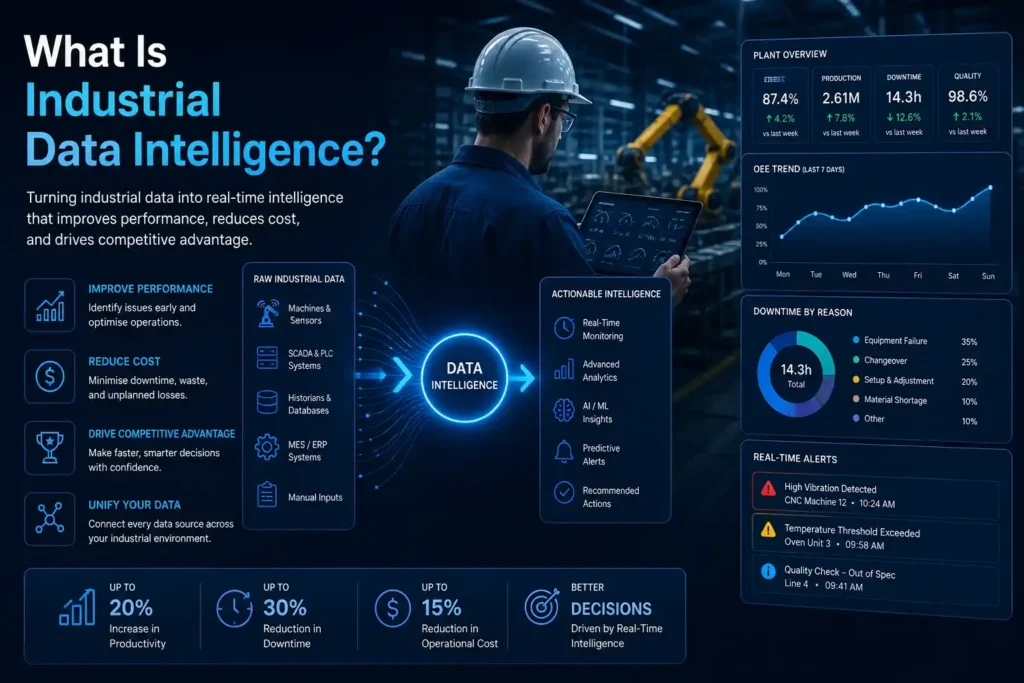
Industrial Data Intelligence is the capability of collecting, contextualising, and converting operational data from across an industrial environment into real time decisions that improve performance, reduce cost, and drive competitive advantage.
It is worth being precise about what this means and what it does not mean. Industrial data management focuses on storing and organising data. Standard manufacturing analytics focuses on reporting what happened. Industrial Data Intelligence goes further than both. It connects every data source across the operation, applies AI and advanced analytics to that unified data, and delivers actionable intelligence to the right person at the right moment with a clear recommended action attached.
It is not a single tool or a single platform. It is an integrated capability that transforms how an industrial organisation thinks, operates, and competes. The factory stops reacting to what happened and starts acting on what is about to happen.
Why Industrial Data Intelligence Is Now a Business Priority
Two forces are making this urgent right now and neither shows any sign of slowing down.
First, the volume of industrial data is accelerating at a pace most organisations are not prepared for. The world now has close to 37 billion connected devices generating over 70 zettabytes of data annually. The majority of that data originates on industrial shop floors and is never used. It sits in systems that were built to store, not to interpret.
Second, the most forward thinking manufacturers have already recognised that data collection alone creates no value. The purpose of data in manufacturing is shifting from monitoring to control. Real time control is becoming the goal, not just awareness. Industrial Data Intelligence is the capability that makes that shift possible. Without it, manufacturers continue investing in infrastructure that generates noise rather than intelligence, and the gap between them and their competitors widens with every shift.
The Four Pillars of Industrial Data Intelligence
Industrial Data Intelligence is not built in a single step. It rests on four interconnected pillars, each one essential to making the whole system work.
Pillar 1: Data Connectivity
Industrial Data Intelligence begins with connecting every data source across the operation. IoT sensors, SCADA systems, ERP platforms, MES, machine controllers, and supply chain feeds all flow into a single unified platform. No silos. No manual handoffs between departments. One continuous, uninterrupted stream of operational truth that every team draws from simultaneously.
Pillar 2: Data Contextualisation
Raw data without context is meaningless. A temperature reading of 220 degrees is just a number until it is tagged with the machine identity, the process stage, the production shift, and the historical baseline for that specific asset. Contextualisation is what transforms raw signals into business relevant information that a plant manager can actually use to make a decision.
Pillar 3: Advanced Analytics and AI
Once data is connected and contextualised, analytics and AI models surface the patterns, anomalies, and predictions that matter. Predictive maintenance, quality anomaly detection, yield optimisation, and demand forecasting all live in this layer. This is where the operation moves from descriptive to prescriptive, from looking at what happened to knowing what to do next.
Pillar 4: Actionable Intelligence Delivery
The final pillar is delivering the right insight to the right person at the right moment with a clear recommended action attached. This is what separates Industrial Data Intelligence from a standard dashboard. A dashboard shows a problem. Industrial Data Intelligence tells the right person what to do about it and when to do it.
Industrial Data Intelligence vs Standard Analytics
This is a distinction worth making clearly because many manufacturers believe they already have what Industrial Data Intelligence describes. Most do not.
Standard analytics answers one question: what happened? It looks backward. It processes structured, predefined data and produces reports, charts, and dashboards that tell leadership how the last shift, week, or quarter performed. That is genuinely useful. But it is not intelligence.
Industrial Data Intelligence answers four questions simultaneously. What is happening right now? Why is it happening? What will happen next? And what should be done about it? This aligns with broader concepts of data intelligence, where organizations move beyond simple reporting to extracting meaningful, actionable insights from complex data environments. The difference is not just technical. It is operational. A manufacturer running standard analytics is always one step behind their operation. A manufacturer running Industrial Data Intelligence is one step ahead of it. That one step is where margin is protected, downtime is prevented, and competitive advantage is built.
What Industrial Data Intelligence Delivers in Practice
When Industrial Data Intelligence is working correctly, the impact is visible across every function of the operation.
Unplanned downtime drops because predictive maintenance catches failure signatures days before they manifest as physical breakdowns. Quality defects are caught at the source during production rather than at final inspection, eliminating the cost of scrapped batches and rework. Supply chain disruptions are anticipated and addressed before they cascade into missed delivery commitments. Leadership decisions are made on live operational data rather than reports compiled from last week’s numbers.
Most importantly, every department from the shop floor to the boardroom operates from a single source of truth. The maintenance team, the quality team, the production team, and the finance team all see the same numbers, in real time, with the same definitions. Arguments over whose data is correct stop. Decisions start.
Frequently Asked Questions
1. What is industrial data intelligence?
Industrial Data Intelligence is the integrated capability of connecting, contextualising, and converting operational data from industrial environments into real time, actionable decisions. It combines data connectivity, advanced analytics, and AI to give manufacturers a live, unified view of their operations and the intelligence to act on what they see.
2. How is industrial data intelligence different from standard analytics?
Standard analytics is descriptive. It tells you what happened. Industrial Data Intelligence is predictive and prescriptive. It tells you what is happening right now, why it is happening, what will happen next, and what the recommended action is. The distinction is the difference between a report and a decision.
3. How does manufacturing data intelligence work in practice?
It works in four stages. First, data is collected continuously from every source across the operation. Second, that data is unified into a single platform and contextualised with business metadata. Third, analytics and AI models surface patterns, anomalies, and predictions. Fourth, the right insight is delivered to the right person with a clear recommended action attached.
4. What industries benefit most from industrial data intelligence?
Any industry with complex physical operations and high data volume benefits. This includes discrete manufacturing, process manufacturing, automotive, electronics, food and beverage, pharmaceuticals, and energy. Any environment where machines, sensors, and production systems generate continuous operational data is a strong candidate.
5. What are the key benefits of a manufacturing intelligence platform?
The key benefits are reduced unplanned downtime through predictive maintenance, improved quality through real time defect detection, faster leadership decisions through live operational visibility, lower operational costs through systematic efficiency improvements, and a single source of truth that eliminates departmental misalignment.
Conclusion
Industrial Data Intelligence is achieved incrementally, not all at once. Manufacturers who see the strongest results start with targeted use cases, prove value quickly, and scale from there. The shift from data collection to data intelligence is not a single technology purchase. It is a deliberate, phased transformation that changes how every level of the organisation operates.
The industrial operations that will define the next decade are not necessarily those with the most machines or the most data. They are the ones that have built the intelligence layer to make every data point count.
Ready to build that layer for your operation? Discover how MyDataInsights helps industrial organisations turn raw operational data into the decisions that drive measurable outcomes.