Introduction
There is a profound sense of confusion in almost every manufacturing boardroom right now. Every leader is being told to invest in AI. Every software vendor promises AI-driven outcomes. However, on the shop floor, most teams cannot clearly tell the difference between what their manufacturing analytics platform does and what their new AI tools are supposed to do. When the expected results do not arrive, nobody knows which specific system failed.
The distinction between AI in manufacturing and standard analytics is not just a technical debate for engineers. It is a practical business problem with real financial consequences. To win, you must understand how these two forces interact to drive actual performance.
What Manufacturing Analytics Actually Is
To understand the landscape, we must define manufacturing analytics across its three primary levels.
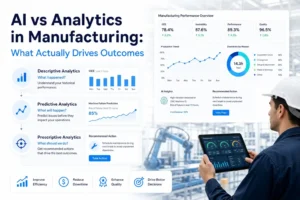
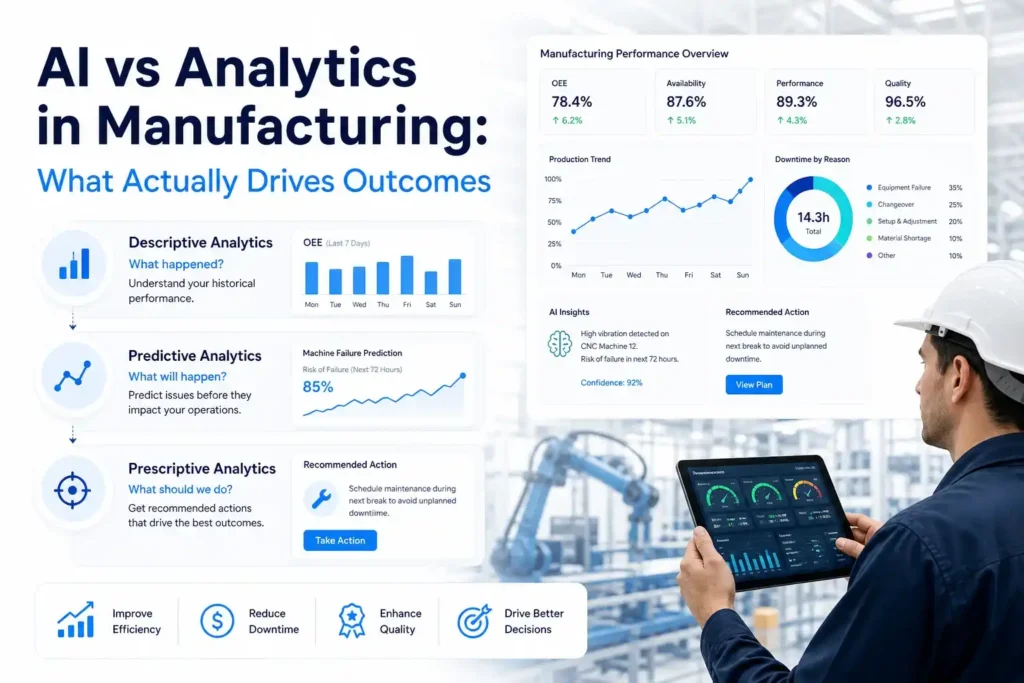
Descriptive Analytics is the baseline. It tells you what happened in the past. A production report showing last week’s OEE or scrap rate is a classic example. Most factories have this level of visibility and nothing beyond it.
Predictive Analytics tells you what is likely to happen next. A model that flags a machine as being likely to fail in the next 72 hours based on specific vibration patterns falls into this category. This is where manufacturing analytics begins to create genuine operational value.
Prescriptive Analytics tells you exactly what to do about a problem. A system that recommends a specific maintenance action during the next scheduled break to avoid unplanned downtime is prescriptive. While many manufacturers have the first level, almost none have reached the third. That gap is where money is being left on the floor every single shift.
What AI in Manufacturing Actually Is
As highlighted by leading enterprise platforms, AI in manufacturing is the application of machine learning models and algorithms to operational data to detect patterns, make predictions, and occasionally take autonomous actions. No hype. No jargon. That is what it is.
The core difference lies in how the systems handle data. Where analytics processes data that humans have already defined and structured, AI finds patterns in data that humans have not yet thought to look for. An industrial AI analytics platform monitoring thousands of sensor variables simultaneously might detect a failure signature three days before it manifests as a physical problem. A dashboard showing that output dropped by 8% last Tuesday is analytics. A manufacturing AI platform predicting that drop before it happens is AI.
AI vs Analytics in Manufacturing: The Real Difference
Understanding the distinction is easier when you compare their primary functions side by side.
| Tasks | Manufacturing Analytics | AI in Manufacturing |
| Primary function | Processes and visualises defined data | Finds patterns in undefined or complex data |
| Output | Reports, dashboards, historical insights | Predictions, recommendations, autonomous actions |
| Requires | Structured data and defined questions | Large data volumes and continuous model training |
| Speed | Real time to batch | Continuous and self improving |
| Human involvement | High, humans interpret and act | Lower, system recommends or acts |
| Best for | Operational visibility and tracking | Lower, the system recommends or acts |
These are not competing technologies. They are complementary layers of a modern manufacturing operation. Analytics gives you visibility into your current state. AI gives you the foresight needed to change your future state. Without analytics, you have no foundation for AI. Without AI, your analytics will always be reactive. Success requires moving beyond the AI vs analytics debate and toward a unified manufacturing data strategy that uses both deliberately.
What Actually Drives Outcomes in Manufacturing
The honest answer is that neither AI nor analytics alone is sufficient. What actually drives outcomes is the combination of clean unified data, analytics that surfaces the right signals, and AI that converts those signals into specific recommended actions.
Research from MESA International and Tech Clarity published in April 2025 found that the top barrier to AI delivering value in manufacturing is not the technology itself. It is inadequate data quality and governance. AI without clean data produces confident but wrong answers. Analytics without AI produces accurate but reactive reports. The manufacturers seeing a real AI manufacturing ROI are those who have built both layers on top of a solid, governed data foundation. You need the prescriptive analytics layer to tell your team what to do once the AI identifies a trend.
Where Each One Fits in Your Manufacturing Operation
Leaders need a practical framework to decide which tool to use for specific problems.
Use a manufacturing AI platform for predictive maintenance, anomaly detection, demand forecasting, yield optimisation, defect classification, and autonomous process adjustments. These are problems where the variables are too complex and too numerous for a human to track manually.
Use manufacturing analytics for real time production monitoring, OEE tracking, quality control dashboards, shift performance reporting, and supply chain visibility. These are problems where structured data and defined questions are enough to drive the right decision.
Use both together when you want a manufacturing operation that can see what is happening, understand why it is happening, predict what will happen next, and recommend the right action before a human even has to ask the question. That is where the real outcomes live.
Frequently Asked Questions
1. What is the difference between AI and analytics in manufacturing?
Analytics focuses on processing known, structured data to show what happened and what is currently happening. AI focuses on finding unknown patterns in complex data to predict what will happen next and suggest how to respond before a problem materialises.
2. Does AI actually improve manufacturing outcomes?
Yes, but only when it is built on a foundation of clean, governed data. When implemented correctly, AI improves OEE, reduces scrap, and prevents unplanned downtime through predictive maintenance analytics. Without clean data underneath it, AI produces confident but unreliable results.
3. Do manufacturers need both analytics and AI or just one?
They need both. Analytics provides the visibility needed for daily operational decisions. AI provides the predictive power needed for long term optimisation and proactive management of the shop floor.
4. What is the role of predictive analytics vs AI in manufacturing?
Predictive analytics is a subset of AI. It uses historical operational data to forecast future events, such as when a machine component is likely to wear out or when demand is likely to spike. It is the bridge between descriptive reporting and fully autonomous AI driven decisions.
5. Where should a manufacturer start, with analytics or AI?
Most manufacturers should start with analytics to get their data foundation in order. Once you have clean, structured, unified data and basic operational visibility, you can layer on factory AI solutions to drive advanced outcomes and measurable ROI.
Conclusion
The core truth is that the question is not AI vs analytics in manufacturing. The real challenge is how you build both layers correctly on top of clean, unified data. Manufacturers who frame this as a competition between the two will invest in one, neglect the other, and wonder why outcomes never materialise.
A true manufacturing AI platform is only as good as the analytics foundation beneath it. If you are ready to stop chasing pilot projects and start driving a real AI manufacturing ROI, it is time to look at your data foundation first.