Introduction
Every plant manager knows the sound of a difficult shift. It is not the loud clanging of the machines. It is the sudden, hollow silence that follows when a primary line goes down. That silence is a gut punch. In that moment, nobody is thinking about operational excellence. They are thinking about the $50,000 in lost revenue that just evaporated, the overtime that will need to be paid on Saturday to catch up, and the inevitable finger pointing that happens in the Monday morning meeting.
The industry likes to cite the statistic that industrial manufacturers lose $50 billion annually to unplanned downtime, but when it is your floor, that number is not a statistic. It is a crisis. The traditional ways manufacturers have tried to reduce manufacturing downtime are failing because they are fundamentally reactive. To win, downtime must stop being treated as an inevitable part of production and start being treated as a data problem that can be solved.
The Failure of the Fix It Later Culture
For decades, manufacturing has relied on two models. The first is reactive maintenance: wait for the belt to snap, the motor to seize, or the sensor to fail, and then scramble to fix it. This is the most expensive way to run a factory. Not only are the repair costs higher because of the urgency, but the manufacturing equipment downtime ripples through the entire supply chain.
The second model is preventive maintenance. Follow the manual. Change the oil every 500 hours. Replace the bearings every six months. It sounds logical, but it is essentially a gamble. Replace a part that still had 30% of its useful life remaining and profit goes straight to the scrap bin. If that same part fails a week before the scheduled service window, the result is still unplanned downtime. Neither of these models uses the intelligence that machines are already generating. They are blind strategies operating in a data rich world.
What Data Intelligence Actually Looks Like on the Floor
When discussing data intelligence for manufacturing downtime, the conversation is not about a simple chart on a screen. It is about an integrated system that listens to the heartbeat of every asset on the floor. Every piece of equipment is constantly broadcasting its health through vibration, heat, sound, and electrical draw.
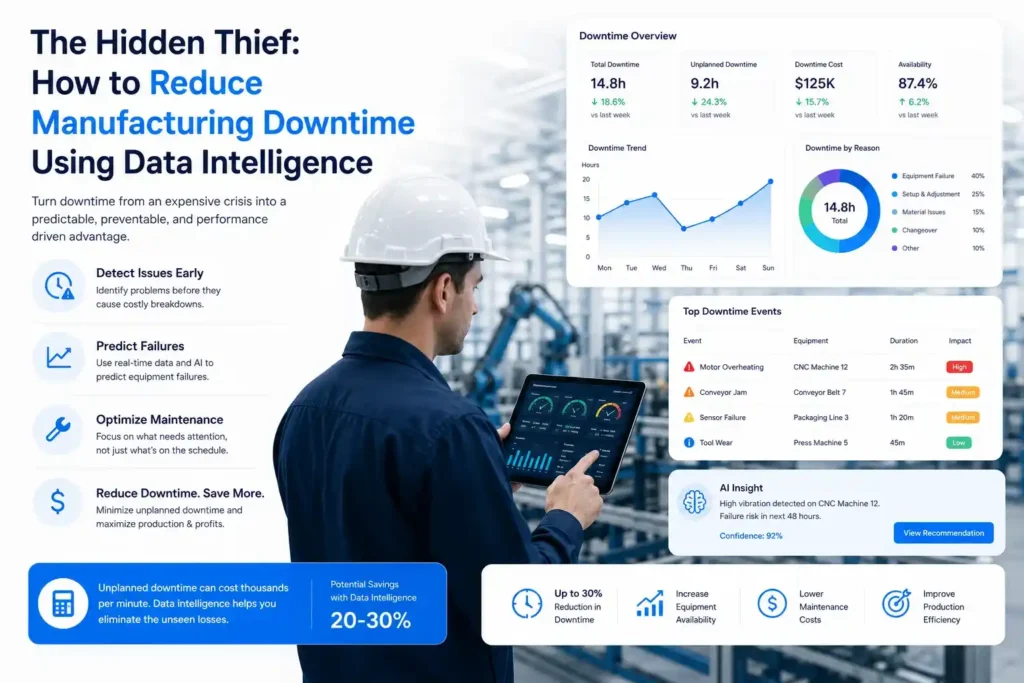
A human operator, no matter how experienced, cannot detect a 0.5% increase in the vibration frequency of a spindle. A manufacturing downtime analytics platform can. By utilising real time machine monitoring, machines are given a voice. Through predictive maintenance in manufacturing, AI filters out the background noise of the factory and identifies the specific failure signatures that precede a breakdown. These signatures are often detectable weeks before a human technician would notice a single physical symptom on the floor.
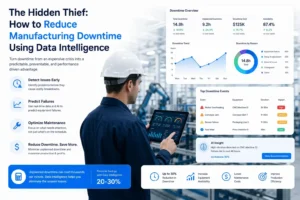
According to McKinsey, predictive maintenance powered by data intelligence can reduce equipment downtime by up to 50% and lower maintenance costs by 10% to 40%. According to Deloitte, manufacturers using data driven predictive maintenance see unplanned downtime cut by up to 70%, maintenance costs reduced by up to 25%, and equipment lifespan extended by 20% to 40%.
The Metrics That Matter: MTTR and MTBF
To achieve meaningful factory downtime reduction, two metrics must be mastered: Mean Time Between Failures and Mean Time to Repair.
MTBF Analytics is the reliability score. MTBF analytics tell operations teams how long a machine stays productive before the next failure. Data intelligence improves this by identifying the environmental factors, such as slightly elevated ambient temperature or specific operator settings, that are causing machines to fail prematurely. The fix is not just to the machine. It is to the conditions that broke it.
MTTR in Manufacturing is the recovery score. When a machine does go down, speed of recovery determines how much production is lost. Most MTTR time in manufacturing is wasted on diagnosis. Technicians spend three hours finding the fault and thirty minutes fixing it. An industrial downtime monitoring system eliminates the search phase entirely. It tells the technician exactly where the fault is before they open their toolbox.
Breaking the Cycle with Downtime Root Cause Analysis
One of the biggest obstacles to factory downtime reduction is the repeat offender: the machine that breaks, gets fixed, and breaks again for the same reason three weeks later. This happens because most maintenance addresses the symptom rather than the cause.
With downtime root cause analysis, a data intelligence platform correlates dozens of variables simultaneously. It might reveal that the motor on Line 3 is not failing because it is old. It is failing because a voltage spike occurs every time the compressor on Line 1 activates. This is manufacturing reliability analytics in action. It moves past the what and into the why, allowing the problem to be solved permanently rather than patched repeatedly.
A Real Scenario: The Case of the Critical Bearing
Consider a critical press that handles 40% of a plant’s throughput. A standard machine downtime tracking system records when it stops and when it starts. Nothing more.
With real time downtime monitoring in manufacturing, the acoustic signature of the press’s main bearings is tracked continuously. On a Tuesday morning, the AI identifies a high frequency harmonic shift. It is not enough to trigger a warning on the console, but the predictive maintenance platform recognises it as an early stage spalling signature.
Instead of waiting for the bearing to seize on a Thursday afternoon and creating four hours of unplanned downtime, the system alerts the maintenance lead. The data is reviewed, the part is ordered, and the replacement is scheduled for the 15 minute window between shifts. A potential $20,000 production loss becomes a $500 routine adjustment. That is how data intelligence for manufacturing downtime works in practice.
The Business Case for Asset Performance
Investing in a manufacturing downtime analytics platform is not a technology spend. It is a margin protection strategy. When manufacturing asset performance improves, hidden capacity is found in existing equipment. New machines do not need to be purchased. The ones already on the floor simply need to stop failing unexpectedly.
Research from Deloitte and McKinsey confirms that companies utilising predictive maintenance in manufacturing see unplanned downtime reduced by up to 70%, maintenance costs lowered by up to 25%, equipment lifespan extended by 20% to 40%, and overall productivity improved by 25%. These are not marginal efficiency gains. They are transformational improvements that compound over time as the system learns more about specific assets and specific failure patterns.
Frequently Asked Questions
1. How can manufacturers reduce unplanned downtime using data intelligence?
By moving from a calendar based maintenance schedule to a condition based one. Real time machine monitoring means maintenance is only performed when data shows it is actually needed, preventing surprise failures and eliminating unnecessary scheduled interventions.
2. What is the ROI of a manufacturing downtime analytics platform?
Most manufacturers see a return on investment within 6 to 12 months. This comes from reduced scrap, lower emergency parts costs, faster repair times, and the elimination of lost production revenue that occurs every time a line stops unexpectedly.
3. Does data intelligence improve MTTR in manufacturing?
Yes. By providing a pre diagnosis before the technician reaches the machine, data intelligence tells maintenance teams exactly what is wrong and where it is. This eliminates the search phase and significantly reduces the time from failure to full recovery.
4. Can industrial downtime monitoring work on older machines?
Yes. Most modern predictive maintenance platforms can deploy external IoT sensors for vibration, heat, and acoustic monitoring on legacy equipment that does not have built in digital connectivity. Age of equipment is not a barrier to entry.
5. How does downtime root cause analysis prevent future failures?
It examines the relationships between different machines, environmental conditions, and operational variables simultaneously. It identifies the invisible causes of failure, such as power quality issues or raw material variations, that standard machine downtime tracking would never surface on its own.
Conclusion
If a manufacturing operation is still being managed by waiting for alarms to sound, success is being left to chance. The technology to see failures before they happen is not a future concept. It is available now, and competitors are already using it.
A manufacturing downtime analytics platform gives maintenance and operations teams the power to win every shift before it starts. Downtime is not inevitable. It is a data problem. And data problems have solutions.