Introduction
Your factory runs 24 hours a day. Your machines generate thousands of data points every minute. Your ERP logs every order, your sensors track every output, and your production floor captures more information in a single shift than your leadership team can process in a week.
And yet, when it comes to making a critical decision about output, maintenance, quality, or supply, most manufacturing leaders are still waiting on a report that was compiled yesterday, built on data from last week.
This is the core contradiction at the heart of modern manufacturing. The data exists. The visibility does not.
Manufacturing Data Intelligence is built to close that gap, turning the enormous volume of data your operations already produce into decisions your leaders can act on, right now.
What Is Manufacturing Data Intelligence?
Manufacturing Data Intelligence is the discipline of collecting, unifying, and analysing data from across manufacturing operations to deliver real-time, actionable insights that drive faster and smarter business decisions.
It goes well beyond traditional reporting. Where a standard business report tells you what happened last month, Manufacturing Data Intelligence tells you what is happening right now and what is likely to happen next.
It connects data from your machines, production lines, supply chain, quality systems, and enterprise software into a single, coherent picture. Rather than siloed spreadsheets and delayed dashboards, it gives leadership a live, unified view of operational performance, built on the data foundation that Industry 4.0 has made possible.
In simple terms, Manufacturing Data Intelligence turns raw operational data into a competitive advantage.
Why Traditional Reporting Is No Longer Enough?
For decades, manufacturing businesses ran on batch reporting. Weekly production summaries. Monthly quality reviews. Quarterly supplier performance reports. This worked when the pace of business allowed for it.
It no longer does.
Today’s manufacturing environment moves faster, competes harder, and carries more operational complexity than at any point in history. Supply chains are global and fragile. Customer expectations are higher. Margins are tighter. And the cost of a single unplanned machine failure or a late shipment compounds quickly.
The problem with traditional business intelligence in manufacturing is not that the data is wrong. It is that it arrives too late. By the time a report reaches a plant head or operations director, the moment to act has already passed. Decisions are made reactively, not proactively.
Manufacturing leaders today need information that moves at the speed of their operations. That means real-time data pipelines, not weekly Excel files. It means predictive models, not post-mortem analysis. And it means a single source of truth that every department, from the shop floor to the boardroom, operates from.
This is precisely what manufacturing data analytics is designed to deliver.
What Does Manufacturing Data Intelligence Cover?
Manufacturing Data Intelligence is not a single tool. It is a capability that spans every function of your operations. Here is what it covers in practice:
OEE and Production Performance
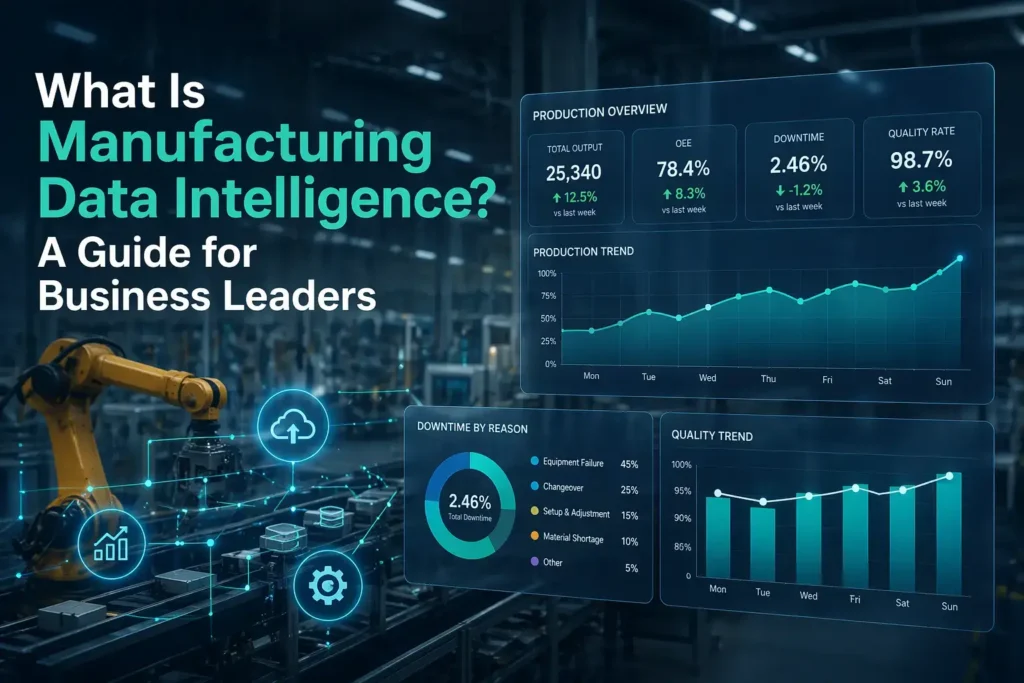
Overall Equipment Effectiveness (OEE) is one of the most critical metrics in manufacturing. Data intelligence platforms track machine uptime, output rates, and production quality in real time, giving operations teams an immediate view of where performance is strong and where it is breaking down.
Predictive Maintenance
Rather than scheduling maintenance on a fixed calendar, or worse, waiting for equipment to fail, predictive analytics in manufacturing uses historical machine data, sensor readings, and AI models to identify failure patterns before they occur. The result is fewer unplanned shutdowns, lower maintenance costs, and longer equipment lifespan.
Real-Time Quality Control
Defects identified at the end of a production run are expensive. Data intelligence enables quality monitoring at every stage of the production process, catching anomalies at the source and reducing waste before it compounds.
Supply Chain Visibility
Big data analytics in manufacturing connects procurement, inventory, and logistics data into one view. Leaders can monitor supplier performance, anticipate shortages, and adjust production schedules dynamically, rather than discovering problems after they impact delivery timelines.
Demand Forecasting
By integrating sales data, market signals, and historical production patterns, manufacturing data platforms generate forward-looking demand forecasts that allow production planning to stay ahead of the market rather than reacting to it.
How Manufacturing Data Intelligence Works
The technology behind Manufacturing Data Intelligence follows a clear, four-stage architecture:
Step 1: Collect Data is gathered from every source across the operation: IoT sensors on the shop floor, machine controllers, ERP systems, MES platforms, SCADA systems, and external supply chain feeds. Industry 4.0 data collection standards make this integration possible at scale.
Step 2: Unify Raw data from disparate systems is centralised into a single data platform, a lakehouse or data warehouse, where it is cleaned, standardised, and structured. This creates the single source of truth that manufacturing organisations have historically lacked.
Step 3: Analyse Real-time dashboards and self-service analytics tools give leadership and operations teams instant access to the metrics that matter. No waiting for a report. No chasing down numbers across departments. The answer is always one screen away.
Step 4: Act AI and predictive models move the organisation from insight to foresight. Rather than simply reporting what happened, the platform recommends what to do next, whether that is rescheduling a maintenance window, adjusting a production target, or flagging a supplier risk before it escalates.
What Business Leaders Actually Gain
The impact of manufacturing analytics solutions is measurable and direct:
- Faster decisions. Leadership operates on live data, not last week’s summary.
- Reduced downtime. Predictive maintenance eliminates the majority of unplanned equipment failures.
- Lower operational costs. Efficiency gains compound across production, quality, and supply chain.
- Consistent metrics. Every department works from the same data, eliminating conflicting reports.
- Scalable intelligence. As operations grow, the platform grows with them.
For one enterprise manufacturing client, implementing a unified data platform delivered a 40% reduction in reporting effort and gave leadership real-time visibility across all business systems for the first time.
Frequently Asked Questions
1. What is manufacturing analytics?
- Manufacturing analytics is the process of collecting and analysing data from production systems, machines, and supply chains to generate insights that improve operational performance. It covers everything from production efficiency and quality control to demand forecasting and predictive maintenance.
2. What is the difference between manufacturing data intelligence and business intelligence?
- Traditional business intelligence in manufacturing typically delivers historical reports, what happened over the past week or month. Manufacturing Data Intelligence goes further by providing real-time visibility and predictive capability, enabling leaders to act on what is happening now and prepare for what comes next.
3. What is the role of predictive analytics in manufacturing?
- Predictive analytics in manufacturing uses machine learning models and historical operational data to forecast future outcomes, most commonly equipment failures, quality defects, and demand shifts. It allows manufacturers to move from reactive to proactive operations management.
4. Is manufacturing data intelligence only relevant for large enterprises?
- No. While large manufacturers have led adoption, the underlying platforms are now accessible to mid-sized operations as well. Any manufacturer generating data from machines, ERP systems, or supply chain processes can benefit from a unified data intelligence approach.
5. How does Industry 4.0 relate to manufacturing data intelligence?
- Industry 4.0 refers to the fourth industrial revolution, the integration of IoT, AI, and connected systems across manufacturing environments. Manufacturing Data Intelligence is the analytical layer that makes Industry 4.0 valuable. Without it, connected machines generate data that nobody acts on. With it, that data becomes the foundation for smarter, faster operations.
Conclusion
Data has never been the problem in manufacturing. The problem has always been what happens to it, or more precisely, what does not happen to it.
Manufacturing Data Intelligence changes that equation. It transforms the operational data your business already produces into a real-time decision-making capability that gives leadership the clarity to act with speed and confidence.
The manufacturers who will lead their sectors in the next decade are not necessarily those with the most advanced machines. They are the ones who can see their operations most clearly and act on what they see.
Ready to turn your manufacturing data into decisions? Book a Strategy Call with MyData Insights