Introduction
For decades, manufacturing ran on experience. A veteran on the shop floor could tell a machine was about to fail just by the sound it made. That institutional knowledge built great factories. But it cannot, on its own, build competitive ones anymore.
Today, margins are tighter, customers are more demanding, and the cost of a single bad decision compounds faster than ever. Experience matters, but experience backed by live data wins.
That is the foundation of data-driven manufacturing. It is not about replacing people with technology. It is about giving the right people the right information at the right moment, so every decision across the production cycle is grounded in fact, not instinct.
What Is Data Driven Manufacturing?
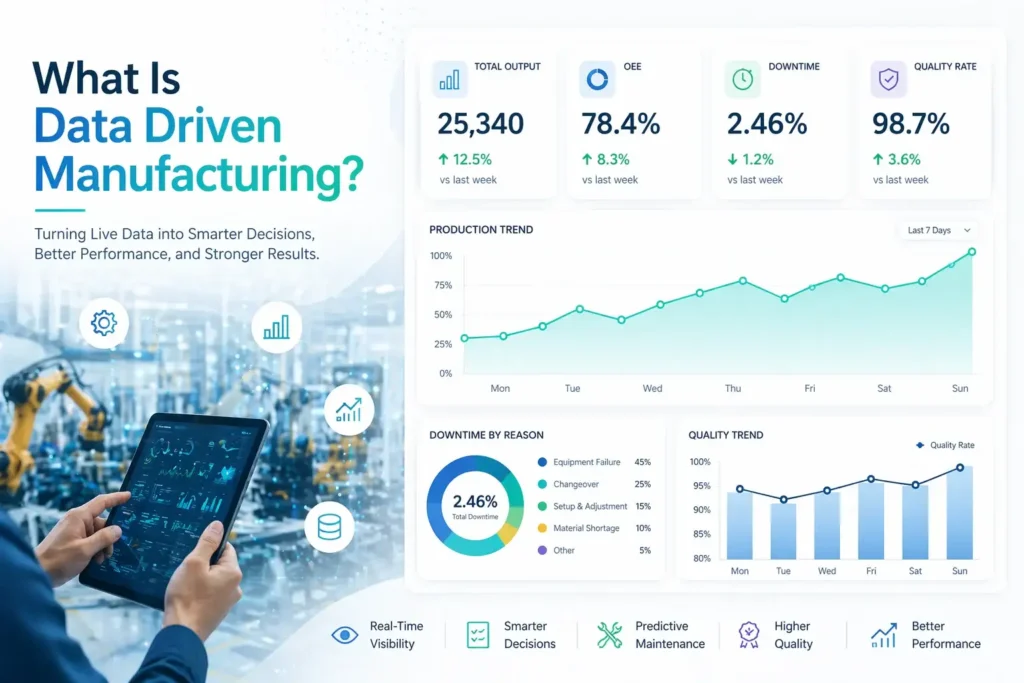
Data driven manufacturing is the practice of collecting, analysing, and acting on data generated across the entire production process to improve efficiency, quality, and operational decision making.
In a traditional setup, data exists but stays locked inside machines, spreadsheets, and departmental systems. Nobody is looking at it together. In a data driven environment, that changes. Every machine, every production line, every supplier interaction feeds into a connected system that gives leadership a single, unified view of operations in real time.
It is not just about having more data. It is about letting data drive every call, from scheduling maintenance to adjusting a production target to catching a quality issue before it becomes a customer complaint.
Why It Matters More Than Ever
The importance of data driven manufacturing comes down to three things: speed, precision, and predictability.
In the past, if a production run produced a 5% defect rate, managers reviewed historical reports a week later and made educated guesses about what went wrong. With a data driven approach, you do not guess. You see exactly when the deviation happened, on which machine, during which shift, and under what conditions.
According to Rockwell Automation’s 2025 State of Smart Manufacturing Report, 95% of manufacturers have already invested in, or plan to invest in, AI and machine learning over the next five years, a clear signal that data driven operations are no longer optional. They will pull ahead of competitors who are still waiting on last week’s report to make this week’s decisions.
The Core Pillars of Data Driven Manufacturing
Let’s list down the core pillars of data driven manufacturing:
Production Efficiency
Data-driven manufacturing solutions give operations teams real time visibility into output rates, cycle times, and throughput. Bottlenecks that once took days to identify are visible the moment they form. Leaders can act before a slowdown becomes a shutdown.
Predictive Maintenance
This is where data driven manufacturing and maintenance come together most powerfully. Rather than fixing equipment after it fails or replacing parts on a fixed schedule, machine learning in manufacturing analyses thousands of variables simultaneously, temperature, pressure, vibration, power consumption, and detects the early signals of failure before they surface as physical problems. The result is maintenance scheduled around actual machine health, not a calendar. Unplanned downtime drops. Equipment lifespan extends.
Quality Control Analytics
Traditional quality control checks the product after it is finished. By then, the time, materials, and energy used to make a defective unit are already lost. Quality control analytics changes this by making quality a real time metric monitored at every stage of production. Quality control data analysis using statistical process control can detect when a process is drifting toward the edge of its tolerance before a single defective unit is produced. Manufacturing quality analytics can also surface patterns across shifts, plants, and suppliers, giving procurement and operations teams data backed reasons to make smarter sourcing decisions.
Data Driven Decision Making
Data driven decision making in manufacturing means every level of leadership, from the plant floor to the boardroom, operates from the same live data. No conflicting reports. No department defending its own version of the numbers. One source of truth that everyone acts on together.
How It Actually Works
The process follows four clear steps:
Collect: IoT sensors, machine controllers, ERP systems, MES platforms, and SCADA systems continuously feed data from across the operation.
Connect: All that data flows into a single centralised platform, a data lakehouse or warehouse, where it is cleaned, standardised, and structured.
Analyse: Real time dashboards and machine learning models surface the patterns, anomalies, and opportunities that matter most to operations and leadership teams.
Act: Instead of waiting for a report, leaders make decisions in the moment, adjusting production schedules, flagging supplier risks, or scheduling maintenance before a failure occurs.
What Business Leaders Actually Gain
When data driven smart manufacturing is working, the impact is visible and measurable:
- Production decisions that used to take days now take minutes
- Defects caught during production, not after delivery
- Maintenance planned around real machine condition, not assumptions
- A single set of KPIs that every team agrees on
- Cost reductions that compound over time as inefficiencies are identified and removed systematically
Frequently Asked Questions
1. What is data driven manufacturing?
Data driven manufacturing is the practice of using real time operational data to guide decisions across the production process, from equipment maintenance and quality control to supply chain management and production planning.
2. What is the role of machine learning in data driven manufacturing?
Machine learning in manufacturing analyses large volumes of operational data to detect patterns humans cannot see at scale. It powers predictive maintenance, quality anomaly detection, and demand forecasting, moving manufacturers from reactive to proactive operations.
3. How does data driven manufacturing improve quality control?
By monitoring quality control data continuously at every stage of production rather than only at the end of the line, manufacturers can catch deviations at the source, reduce waste, and prevent defective products from reaching customers.
4. Is data driven manufacturing only for large factories?
No. While large manufacturers led early adoption, modern data platforms are accessible to mid sized operations as well. Any manufacturer with machines, an ERP system, or a supply chain generates enough data to benefit from a data driven approach.
5. How do manufacturers get started?
The first step is building a solid data foundation, connecting existing systems, standardising metrics, and creating visibility across operations. From there, analytics and AI capabilities can be layered in progressively.
Conclusion
The data your factory generates every day is one of your most underused assets. It sits inside machines, production logs, and supplier systems, largely invisible to the people who need it most.
Data driven manufacturing changes that. It turns operational data into a decision making engine that makes your entire organisation faster, sharper, and more resilient.
The manufacturers who will lead the next decade are not necessarily those with the newest machines. They are the ones who can see their operations most clearly and move on what they see.
Ready to build a data driven foundation for your manufacturing operations? Book a Strategy Call with MyData Insights and let us show you where to start.