Introduction
Almost every plant manager tracks OEE. Very few actually use it to change the outcome of a shift. For most facilities, OEE is a Monday morning autopsy. It is a number reported in a weekly meeting, compared against last month’s targets, and then filed away. By the time the report is seen, the three components that determine it, availability, performance, and quality, have already bled value onto the floor.
The problem is not the metric. Overall equipment effectiveness remains the most honest measure of manufacturing productivity available. The problem is that most manufacturers are looking at OEE through the rear view mirror instead of through the windscreen. To actually improve OEE in manufacturing, it must stop being treated as a scorecard and start being treated as an operational compass.
What OEE Actually Measures and the Gap Most Manufacturers Are Missing
To fix the score, the math behind it must be understood clearly. Overall equipment effectiveness is calculated by multiplying three factors.
Availability is the percentage of scheduled time a machine is actually running versus sitting idle due to unplanned downtime. Performance is the speed at which it runs relative to its maximum designed capacity versus slow cycles and micro stoppages. Quality is the proportion of output that meets specification the first time versus scrap and rework.
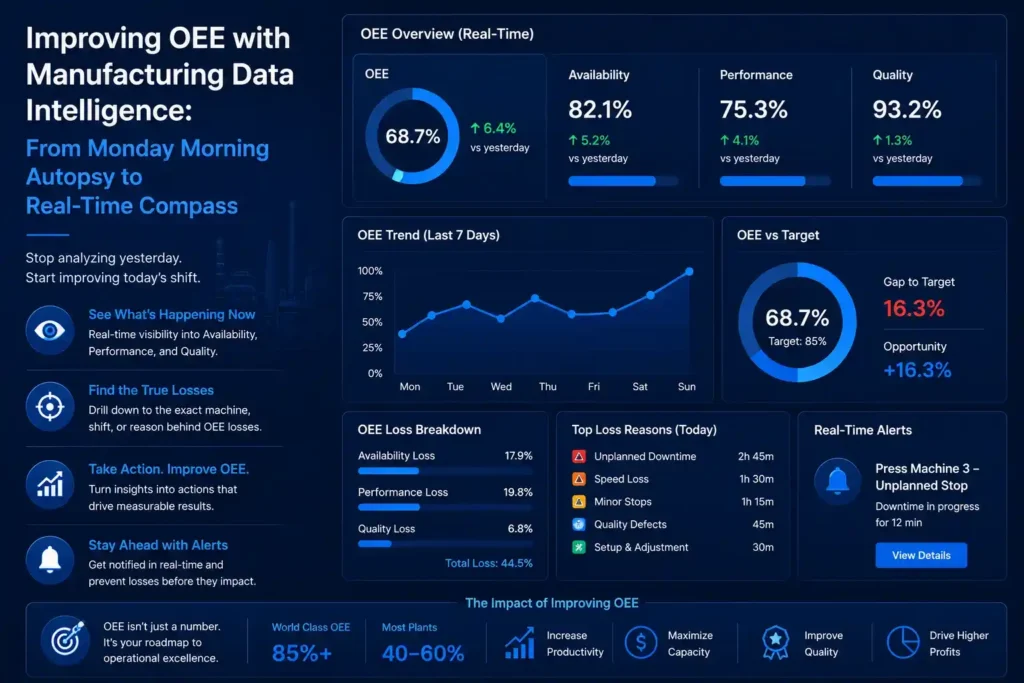
Industry benchmarks widely recognise 85% as world class OEE performance, although most manufacturers still operate well below that threshold.. The reality on most production floors is that manufacturers sit between 40% and 60% and cannot pinpoint exactly why. That gap represents enormous untapped capacity that has already been paid for. It is sitting on the floor, invisible and unused, every single shift. Traditional OEE tracking fails because it aggregates this data too broadly, hiding the specific machine, shift, or operator where the loss is actually occurring.
Why Traditional OEE Dashboards Fail the Shop Floor
Most OEE dashboard setups suffer from three significant flaws. First, they are descriptive rather than prescriptive. They tell operations teams that the score is 62% but do not tell anyone what to do about it. Second, they rely on batch reporting, meaning the data reaching decision makers is hours or even days old by the time it is reviewed. Third, they ignore the invisible losses, those 30 second micro stoppages that do not trigger an alarm but accumulate into hours of lost production by the end of the week.
This is where OEE data intelligence changes the game entirely. It moves the metric from a static historical report into a live management system that plant managers can act on in real time.
How Manufacturing Data Intelligence Transforms the Three Pillars of OEE
When manufacturing data intelligence is applied to OEE, the operation stops reacting to failures and starts managing outcomes.
Availability: Eliminating the Unplanned Stop
Unplanned downtime is the single biggest destroyer of overall equipment effectiveness. Instead of waiting for a machine to stop, OEE predictive analytics identifies failure signatures in vibration, temperature, and acoustic data days before a breakdown occurs. By transforming OEE into a real time operational compass, manufacturers can improve equipment effectiveness by 50% or more by moving maintenance into planned windows rather than responding to emergencies. Availability stops being a matter of luck and becomes a managed, predictable variable.
Performance: Eliminating the Silent Slowdown
Performance losses are often invisible. A machine is running, so no alarm sounds, but it is running at 87% of its designed throughput rate. Over an eight hour shift, 13% of production capacity has been lost without a single alert. Real time OEE monitoring surfaces these speed reductions and micro stoppages the moment they occur. Plant OEE analytics allow a supervisor to see that a feed rate has drifted and correct it in ten minutes rather than losing the entire shift target.
Quality: Catching Drift at the Source
First pass yield is the final component of OEE and the one where quality control data intelligence has the most direct impact. Traditional quality control happens at the end of the production line. If a part is defective, the time and energy invested at every previous stage are wasted. OEE improvement using data intelligence monitors process parameters continuously. If a tool is wearing down or a temperature is drifting at Stage 2, the system flags it immediately. Catching a quality drift early eliminates the compounding cost of adding production value to a unit that will ultimately be scrapped.
Real Time OEE Monitoring vs Batch Reporting
The difference between a traditional OEE dashboard and a real time OEE tracking platform is the difference between a photograph and a live video feed. A photograph shows what the factory looked like at 8am. It is largely useless by 10am.
A live feed gives plant managers the ability to intervene while the shift is still running. Every hour of delay between an OEE loss event and a management response is an hour of compounding inefficiency that cannot be recovered. Using OEE monitoring software for factories ensures that response time to a performance dip is measured in minutes rather than days.
OEE Benchmarking: Replicating the Perfect Shift
One of the most underused OEE improvement strategies is internal benchmarking, comparing performance not just against industry standards but against the operation’s own best results. Plant OEE analytics allow direct comparison of Shift A against Shift B, or Line 1 against Line 2.
If Line 1 consistently achieves a 78% OEE while Line 2 struggles at 60%, data intelligence enables a drill down into the variables driving that gap. Is it operator training? Raw material from a specific supplier? A difference in maintenance cycles? By identifying where best practice already exists within the operation, it can be systematically replicated across every line and every shift. Even a 5% improvement in OEE across a two shift plant represents a significant increase in effective production capacity without adding a single new asset to the floor.
Frequently Asked Questions
1. What is OEE and why does it matter in manufacturing?
Overall equipment effectiveness is the gold standard metric for measuring how productively manufacturing equipment is being used. It matters because it exposes exactly where production value is being lost, whether through unplanned downtime, slow running machines, or defective output, and quantifies that loss in a single, comparable score.
2. How does data intelligence improve OEE in manufacturing?
It moves OEE data from historical reporting to real time visibility. OEE predictive analytics prevents downtime before it occurs, real time monitoring surfaces silent performance losses as they happen, and continuous quality monitoring catches defects at the source rather than at final inspection.
3. What is the difference between traditional OEE tracking and real time OEE monitoring?
Traditional OEE tracking reports what happened yesterday or last week. Real time OEE monitoring shows what is happening right now, giving plant managers the ability to intervene and recover a shift while it is still running rather than reviewing the damage after it has ended.
4. What is a world class OEE score?
85% is widely considered world class in manufacturing. Most plants operate between 40% and 60%. Closing that gap through data intelligence is one of the fastest ways to increase production capacity and profitability without purchasing new equipment.
5. How do manufacturers use OEE analytics to drive continuous improvement?
They use overall equipment effectiveness analytics to identify the specific root cause of each category of loss. Rather than making general efforts to improve, they have specific data pointing to which machine, which shift, which process parameter, or which supplier is driving the gap between current performance and world class.
Conclusion
OEE is the most honest measure of manufacturing performance available. It cannot be presented favourably in a boardroom if the underlying numbers do not support it. It either shows a plant running close to its potential or one leaving significant production capacity on the floor every single shift.
Manufacturing Data Intelligence transforms OEE from a post mortem report into a live management system. The gap between a 60% OEE score and the 85% world class benchmark is not filled by working harder. It is filled by seeing more clearly and acting faster.
Ready to move your OEE score from where it is to where it should be? Discover how MyDataInsights helps manufacturers close the gap between current performance and world-class.