FlowSync vs TallyPrime
FlowSync vs TallyPrime — for a manufacturer, not just an accountant
Tally isn't the problem. Tally is excellent at what it was built for — accounting, GST and statutory filing. The problem is what happens on the floor between the order landing and the invoice being raised. That part never lived in Tally, and no amount of TDL customisation makes it live there. If your accountant loves Tally and your operations director is drowning in spreadsheets and WhatsApp, you do not have a Tally problem — you have a gap between the books and the plant floor.
Where TallyPrime is genuinely strong
Say this plainly, because it is true. Tally gives you deep double-entry accounting, mature GST returns and statutory compliance, decades of chartered-accountant familiarity, fast voucher entry, and it runs offline on a modest machine for a low, one-time cost. For pure book-keeping and filing, it is hard to beat and we will not pretend otherwise.
If your business is trading or services and your inventory is simple, Tally may be all you need. Be honest with yourself about that before spending on anything else.
Where it leaves a manufacturer exposed
Tally records transactions. It does not run an operation. For a factory, that shows up as:
No order-to-dispatch workflow
A customer order isn't linked to live finished-goods stock or work-in-progress, so confirmations and planning run on someone's memory and a spreadsheet.
No quality gate
Nothing stops uninspected material moving into production or un-cleared stock being dispatched. In Tally, a stock item is a stock item.
No production visibility
Job cards, material issues, machine runtime, rejection counts — these sit outside Tally, usually in Excel, disconnected from the stock and the ledger.
No role-based floor use
A store manager, a QC officer and a dispatch clerk all need different screens. Tally is one accounting interface, built for the accounts team.
Stale, not live
By the time a report is pulled, the number has moved. Decisions run on last week’s picture.
FlowSync — built the other way round
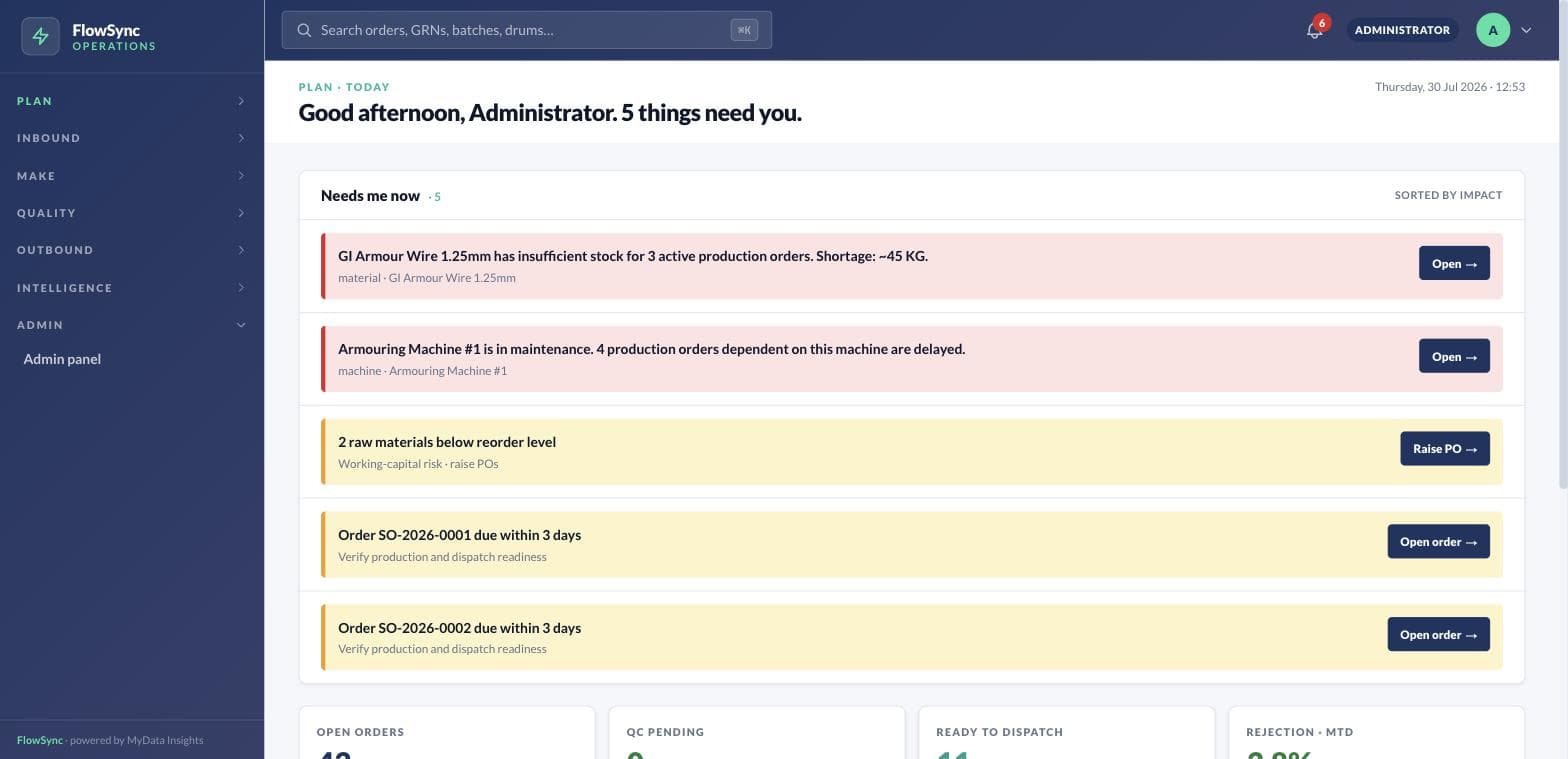
FlowSync starts on the floor and connects the chain: inward QC clears stock, stock feeds order readiness, readiness drives production, production QC confirms the accepted quantity, and only that accepted quantity can be dispatched — with the invoice posting revenue and GST. Every step feeds the next, and each one keeps the ledger correct as it happens — full double-entry, GST tax invoices, GSTR-1/3B and 2B reconciliation included.
So you get Tally-grade accounting wired directly to production and dispatch data — which Tally, on its own, does not do.
Honest comparison
| Capability | TallyPrime | FlowSync |
|---|---|---|
| Double-entry accounting & GST filing | Excellent, mature | Full double-entry, GST returns + 2B recon built in |
| Statutory breadth (payroll, wide report library) | Broad | Focused on manufacturing finance |
| Order → production → QC → dispatch flow | Not built | Core — each step gates the next |
| Quality gates (inward & production QC) | No | Yes — un-cleared stock cannot dispatch |
| Live inventory across teams | Voucher-based, not real-time | Real-time, role-based |
| Role-based screens for non-accounts staff | One accounts interface | Store, QC, production, dispatch each get their own |
| Machine OEE, operator productivity | No | Yes |
| Runs offline | Yes | Cloud, multi-device |
| Pricing model | One-time licence | ₹19,999 + GST/year · 5 users, cloud & AI · free trial |
When to choose which
Stay on Tally alone
if your accountant is happy, your inventory is simple, and your bottleneck is book-keeping, not operations.
Add FlowSync
if orders still run on spreadsheets and verbal coordination, if you can't see live stock at the moment you decide to buy or produce, or if dispatch happens without a clean QC-cleared number. Many teams keep Tally for statutory books and run FlowSync for operations — we export cleanly so the two don't fight.
Common questions
Can FlowSync replace Tally for accounting?
For a manufacturer’s needs — invoices, GST, ledgers, AR/AP, banking and financial reports — yes. Some teams keep Tally for statutory books and run FlowSync for operations; FlowSync exports cleanly so the two do not fight.
Do I lose GST compliance if I move to FlowSync?
No. FlowSync includes full double-entry accounting with GST tax invoices, GSTR-1/3B and 2B reconciliation. e-Invoice and e-Way Bill are ready to switch on through your GST Suvidha Provider.
Is FlowSync per-user like some ERPs?
No. The ₹19,999 + GST/year plan includes 5 users, cloud hosting and AI, so you are not penalised for putting the shop floor on it. Add users as you grow.
Get started
See FlowSync on your own factory
₹19,999 + GST/year — 1 company, 1 plant, 5 users, cloud and AI included. Start a free trial or take a 15-minute demo.